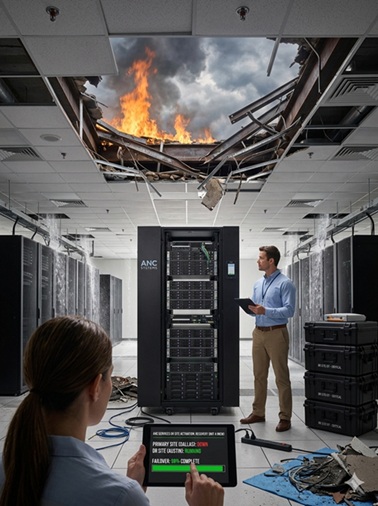
Ransomware, hardware failure, flooding, fire, prolonged power outages — every one of these is a potential IT disaster for a small business, and none of them send advance notice. ANC Systems develops, documents, and maintains IT disaster recovery plans and business continuity strategies for small and mid-sized businesses throughout Naperville, IL and the greater Chicagoland area — so your organization knows exactly what to do when something goes catastrophically wrong, and can prove it works before the test is real.
Research consistently shows that a majority of small businesses that experience a major IT disruption without a documented recovery plan in place never fully recover. Not because the data couldn't have been restored — but because nobody knew in what order to restore it, who was responsible for each step, how to communicate with clients while systems were down, or which systems were actually critical enough to prioritize. A plan changes all of that. The absence of one makes everything worse.
Ransomware is now the most common IT disaster facing small businesses. It encrypts every file on your network and shuts down operations completely. Without a documented recovery plan and immutable backups, the choice becomes pay the ransom or rebuild from scratch.
Severe weather, flooding, and power surges are real threats across Chicagoland. A lightning strike, a basement server room flood, or a sustained power outage can take your entire infrastructure offline — and without an offsite recovery capability, operations stop entirely.
A server or storage array failure at the worst possible moment can shut down every application your business depends on. Without a documented recovery procedure and a tested restoration process, "we have backups" is not the same as "we can get back online."
Even businesses with good backups routinely fail during recovery because nobody documented which systems to restore first, in what order, what the dependencies are, or who is responsible for each step. A plan turns a chaotic crisis into a managed sequence of decisions.
ANC Systems delivers a complete IT disaster recovery planning and business continuity program for small and mid-sized businesses throughout Naperville, IL and across DuPage, Will, Kane, and Cook counties. We don't hand you a template document and disappear — we design, implement, test, and maintain your recovery capability as a living program that evolves as your business does.
A systematic review of your critical systems, processes, and data — identifying what your business cannot operate without, in what priority order recovery must happen, and what the financial and operational impact of downtime actually is for each critical function.
A written, actionable IT disaster recovery plan with defined RTO and RPO targets for each critical system, step-by-step restoration procedures, staff roles and decision authority, vendor contact lists, and communication templates — not a generic framework, but a plan specific to your actual environment.
Scheduled recovery testing — both technical restore tests and structured tabletop exercises — that verify your plan actually works, identify gaps before a real event exposes them, and keep your team practiced on recovery procedures so a crisis doesn't become their first rehearsal.
Cloud-based disaster recovery infrastructure that can spin up your entire business environment — servers, applications, and data — in the cloud within hours of a site-wide disaster. A complete secondary environment available on demand, without the capital cost of maintaining a physical DR site.
Beyond IT recovery — a broader business continuity plan that addresses how your business operates during a disruption: employee communication and temporary work arrangements, client notification procedures, vendor escalation contacts, and decision authority when key staff are unavailable.
For businesses in regulated industries, disaster recovery isn't just risk management — it's a compliance requirement. We align your DR plan to HIPAA, PCI-DSS, NIST, and other applicable frameworks, producing the documentation your auditors expect as a deliverable of the engagement.
The difference between a business that recovers in hours and one that struggles for weeks almost always comes down to preparation made long before the incident. Here are three situations from businesses throughout Naperville and the greater Chicagoland area.
A DuPage County accounting firm was hit by ransomware during their busiest period of the year. They had data backups in place — but no documented restoration sequence, no defined staff roles during recovery, no client communication plan, and no one with clear authority to make recovery decisions under pressure. Their IT vendor worked around the clock for 96 hours. Three weeks of client work had to be reconstructed from paper records. Two client relationships were permanently damaged due to missed deadlines and poor communication during the incident.
A Will County manufacturer's server room flooded during a heavy spring rain, damaging their primary file server, backup NAS device, and networking equipment simultaneously. Their backup was local-only — stored on the NAS device that was also destroyed. Without any offsite or cloud recovery capability, the company had to order replacement hardware, rebuild servers from scratch, and recover what data they could from individual workstations. Eleven days of production downtime during a period of high customer demand cost them a significant contract and multiple missed delivery commitments.
A Naperville medical practice passed their initial HIPAA security risk analysis but received a cited deficiency during a follow-up audit when the auditor requested their contingency plan — specifically, documented procedures for data backup, disaster recovery, emergency mode operations, and testing activities, all required under HIPAA's contingency plan standard (45 CFR § 164.308(a)(7)). The practice had a data backup in place but no written contingency plan, no documented testing, and no emergency mode operating procedure. The deficiency required remediation before their next audit cycle.
Most small businesses that think they have a disaster recovery plan actually have a backup solution — and confuse the two. A documented IT disaster recovery plan contains specific, actionable content that goes far beyond "we have backups." Here is what a complete plan includes for a Naperville or Chicagoland small business.
An inventory of every IT system your business depends on, ranked by criticality. Which systems, if offline, stop your business immediately? Which can tolerate 24 hours of downtime? Which can wait a week? This priority order drives every other decision in the recovery plan — and without it, recovery is guesswork under pressure.
Recovery Time Objective (RTO): how long can this system be offline before the impact becomes unacceptable? Recovery Point Objective (RPO): how much data can you afford to lose, measured in time? These targets are defined per system — not as a single blanket standard — and they drive the backup frequency and recovery architecture for each.
Specific, numbered procedures for restoring each critical system — written clearly enough that someone other than your regular IT contact could execute them under pressure. Who does what, in what order, using which tools, from which recovery source, with which credentials. Ambiguity during a recovery event is expensive.
During a crisis, decision-making authority must be pre-established. The plan defines who declares a disaster event, who coordinates the recovery, who communicates with clients and vendors, who manages alternate work arrangements, and who has the authority to make technology purchasing decisions under emergency conditions.
Pre-written communication templates for employees, clients, vendors, and insurers — drafted before the crisis, not improvised during it. Includes employee notification procedures, client service impact disclosures, vendor escalation contacts, and cybersecurity incident notification obligations where applicable.
A disaster recovery plan written two years ago and never touched is not a plan you can rely on — your systems have changed. Every plan ANC Systems develops includes a documented testing cadence, a tabletop exercise schedule, and a defined trigger list of IT environment changes that require a plan review and update.
ANC Systems has experience designing and managing disaster recovery solutions built on the leading platforms used by small and mid-sized businesses. We match technology to your recovery objectives, your budget, and your existing infrastructure — and manage it so your DR capability stays current and tested.
A generic DR template with your company name inserted at the top is not a disaster recovery plan — it's a liability. Every ANC Systems DR engagement begins with a genuine business impact analysis of your specific systems, produces a plan with actual restoration procedures for your actual environment, and ends with a tested capability rather than a filed document.
A plan that has never been tested has an unknown failure rate. ANC Systems schedules and conducts technical recovery tests, structured tabletop exercises, and plan review cycles as part of every disaster recovery engagement. When a real event occurs, your team has already rehearsed the response — and we've already found and closed the gaps.
A disaster recovery event is not the time to manage a remote support relationship with a vendor you've never met in person. ANC Systems is based in Naperville and can dispatch technicians throughout Chicagoland. During a recovery event, we're hands-on at your location — not coordinating remotely from another state while your business is offline.
For healthcare, financial services, and legal businesses throughout the Chicagoland area, disaster recovery planning isn't optional — it's a regulatory requirement. Every DR plan ANC Systems develops produces the specific documentation required by HIPAA, PCI-DSS, NIST, and FTC Safeguards, formatted for use in audits and client due diligence reviews.
Your IT environment changes continuously — new applications, new staff, new locations, migrated servers. A DR plan written two years ago for a different environment is not a plan you can rely on. ANC Systems maintains your plan as a living document, triggering reviews on a defined schedule and whenever your environment changes significantly.
Disaster recovery doesn't exist in isolation. It depends on your backup strategy, your security controls, your network architecture, and your cloud configuration. Because ANC Systems manages all of these for our clients, your DR plan is designed in full awareness of your actual environment — not drafted by someone who has never seen your infrastructure.
Our disaster recovery and business continuity engagements are comprehensive by design. A typical program for a Naperville or Chicagoland business includes:
Disaster recovery is the process of restoring your IT systems and data after a disruptive event. It answers the question: how do we get our technology back online? Business continuity is the broader organizational plan for keeping your business operational during and after a disruption — it covers not just IT restoration, but how employees work during the outage, how clients are notified and served, how vendors are managed, and how key decisions get made when normal operations are impossible. Disaster recovery is a critical component of business continuity, but business continuity covers the full picture. ANC Systems addresses both for Naperville and Chicagoland businesses — not just the technical recovery, but the complete organizational response.
A complete IT disaster recovery plan contains: a business impact analysis identifying your critical systems in priority order; Recovery Time Objectives (RTO) and Recovery Point Objectives (RPO) for each critical system; documented restoration procedures specific to your actual environment; defined staff roles and decision authority during a recovery event; pre-written communication templates for employees, clients, and vendors; a complete vendor and escalation contact list; and a documented testing and review schedule. For regulated businesses, it also includes the specific documentation required by HIPAA, PCI-DSS, NIST, or other applicable frameworks. A service agreement from your IT vendor, or a backup solution, is not a disaster recovery plan — however valuable those things are independently.
Industry best practice calls for at least annual full plan testing, quarterly tabletop exercises, and technical recovery tests of individual critical systems on a defined schedule — typically monthly or quarterly depending on your RTO targets. Beyond scheduled testing, any significant change to your IT environment — a server migration, a new line-of-business application, a staff reorganization, a new location — should trigger a plan review. A plan written for your environment from two years ago is not necessarily a plan for the environment you have today. ANC Systems builds testing schedules into every DR engagement as a standard deliverable, not an optional add-on.
Yes. HIPAA's Security Rule includes a Contingency Plan standard (45 CFR § 164.308(a)(7)) that requires covered entities and business associates to implement policies and procedures for responding to emergency or disaster situations. This standard mandates five specific components: a data backup plan, a disaster recovery plan, an emergency mode operations plan, testing and revision procedures, and an applications and data criticality analysis. These are not recommendations — they are required implementation specifications. ANC Systems develops HIPAA-compliant contingency plans for healthcare practices, medical billing companies, and other covered entities throughout Naperville and Chicagoland — producing all five required components as documented deliverables that can be presented during an audit or breach investigation.
Disaster Recovery as a Service (DRaaS) is a cloud-based DR approach in which a provider maintains a secondary cloud environment capable of running your critical systems within a defined recovery time window after a site-wide disaster. Unlike traditional DR solutions that require maintaining physical secondary hardware, DRaaS uses cloud infrastructure — meaning you pay for the capability without the capital cost of a dedicated secondary site. Whether a small business needs DRaaS depends on their RTO requirements and the nature of their most likely disaster scenarios. A business that can tolerate 24–48 hours of downtime may be well-served by a traditional backup and restore approach. A business that must be back online within four hours after a site-wide event — for operational, financial, or compliance reasons — needs a solution like DRaaS. ANC Systems assesses your specific requirements and recommends the approach that matches your actual recovery objectives.
ANC Systems primarily serves small and mid-sized businesses — typically companies with 5 to 150 employees — throughout Naperville, IL and the greater Chicagoland area, including Aurora, Bolingbrook, Lisle, Downers Grove, Wheaton, Woodridge, Oak Brook, Schaumburg, Lombard, Elmhurst, Joliet, Romeoville, Plainfield, and surrounding communities across DuPage, Will, Kane, and Cook counties. We provide disaster recovery planning, DRaaS implementation, testing, and ongoing plan maintenance for businesses of all complexity levels — from a 10-person professional services firm with a single server to a 100-person multi-site operation with complex compliance requirements.